The trouble with a word
Most trip pages show you a photo and a word such as moderate. You book on that word, and on the third day you learn that the pass is 1,176 m of ascent in a single day. I started Waymark so that nobody has to find out that way. We grade by the numbers, not by feel, and we publish the numbers of every day before you book.
The scale
There are five grades, and each one is a rule you can test against a table of days.
- Grade 1: Up to 12 km and 400 m of ascent a day on good paths.
- Grade 2: Up to 14 km and 1,000 m of ascent on the hardest day. Clear paths, no exposure.
- Grade 3: One or two days with more than 1,000 m of ascent. Some steep, rocky ground.
- Grade 4: Three or more days in a row with over 800 m of ascent, or sections with fixed cables.
- Grade 5: Glacier or scrambling. We do not run grade 5 trips.
We run one route at grade 2, two at grade 3 and three at grade 4. Nothing is on sale at grade 1 or grade 5, but I show the scale in full so you can see where each route sits.
How a route gets its grade
I take the day table and hold it against the scale, starting at grade 1. If a single day breaks a limit, the route moves up a grade and I test it again. The grade is set by the hardest day, or by the hardest run of days. Easy days elsewhere on the route do not lower it.
The Grava Pass, day by day
The route over the Grava Pass is the one I use to explain this. Its first two days are gentle. Day 1 covers 9.0 km to the farm at Malga Pradel and climbs 158 m over the whole day. Day 2 covers 9.9 km to Rifugio Lago Scuro, on the shore of a lake, and its climbing adds up to 212 m. The last day is 6.8 km into Val Dores, with 666 m of descent in all. On their own, the numbers of those three days sit inside the limits of grade 1.
Day 3 decides the grade. Its 14.3 km include a climb of 1,176 m from the lake to the Grava Pass at 2,625 m. Then you come down the far side to Rifugio Grava at 2,162 m. That is more than 1,000 m of ascent and more than 14 km in one day, so grade 2 is ruled out.
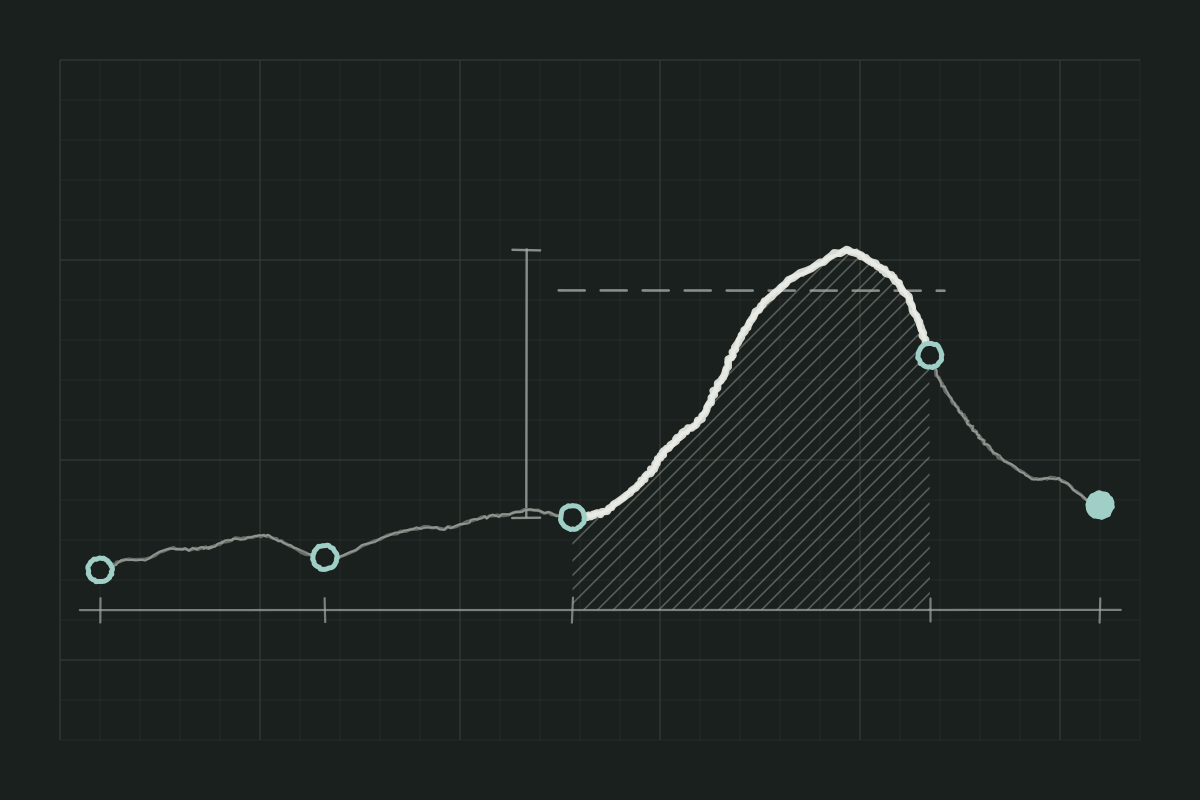
One day like that is enough to set the grade, however easy the other three are. Nothing else on the route reaches higher on the scale. So the Grava Pass Traverse is grade 3, and its card says Grade 3 of 5.
The Grauer Joch at 2,860 m, still grade 2
The highest point of a route does not set its grade. The Ötztal Hut Taster crosses the Grauer Joch at 2,860 m, higher than the Grava Pass, and it is grade 2. Its biggest climb is 986 m in 4.4 km to Fernerblick Hut, and its longest day is 13.8 km. Both sit inside the limits of grade 2. The Grauer Joch is a broad saddle, and the path over it never needs your hands.
What makes a route grade 4
Grade 4 comes from a run of hard days or from cables. The Julian Lakes Crossing climbs 872 m, 995 m and 1,037 m on its first three days. That is three days in a row over 800 m. The High Dolomites Hut Route never climbs 800 m in a day, but its last day crosses Forcia Ridge on fixed cables.
Using the grade
Read the grade first and the day table second. Set its hardest day beside the hardest day you have walked at home, with a full rucksack and another day to follow. If you are unsure which route fits, say so in your enquiry. Owen Pryce reads every enquiry and calls you to talk through the route.